Build the model
Each team forecasts five years of cash flow in Excel, works out the discount rate (WACC) and adds a terminal value.

Valuation: M&A with DCF
Students value an M&A target with a full DCF model, then negotiate the price with the team on the other side of the deal. Professors can monitor progress, manage timings and use the final deals for debriefing or optional assessment.
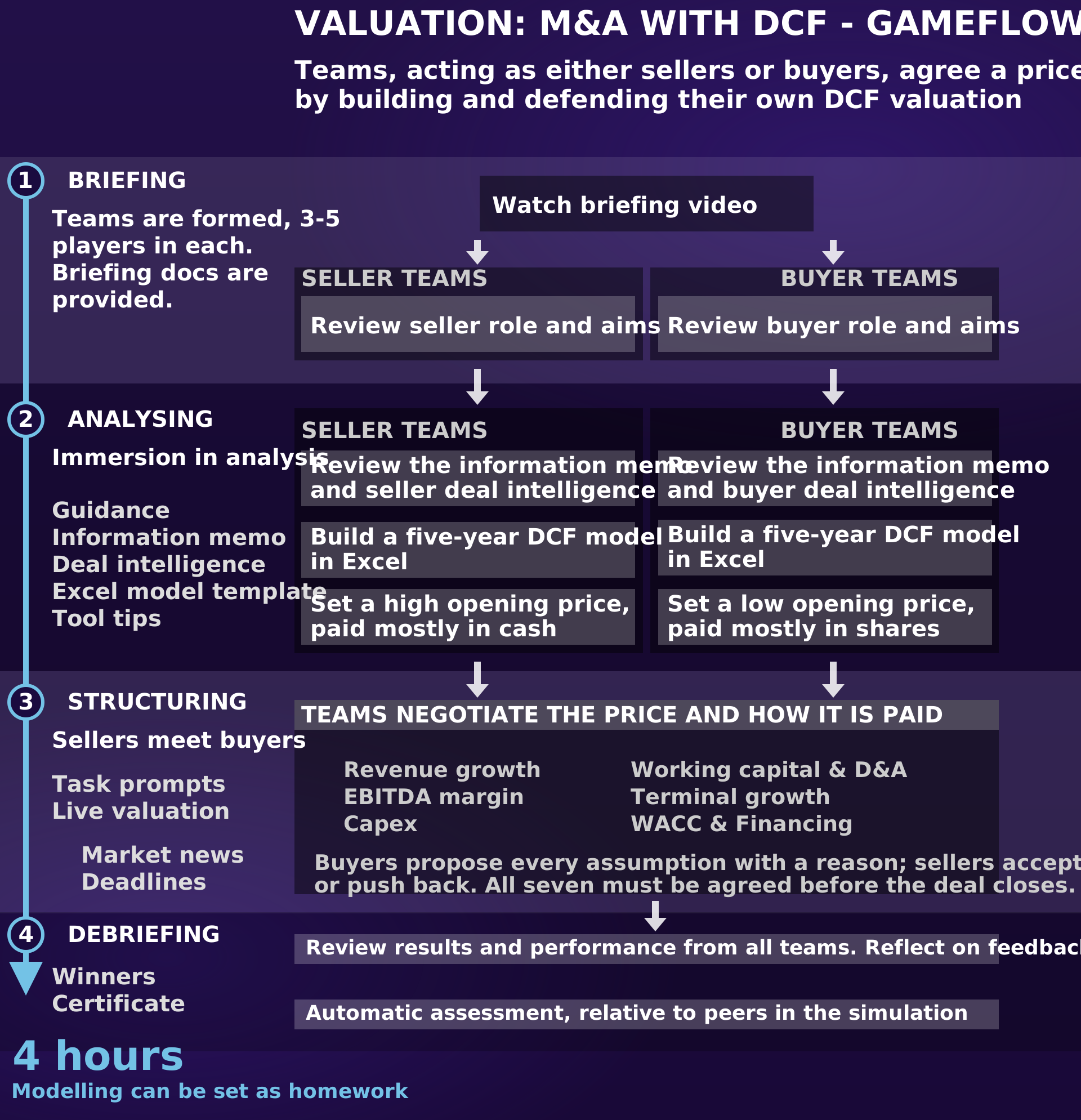
Two teams value the same acquisition target from the same information pack, build their own five-year forecast in Excel, and arrive hundreds of millions apart. They then have to agree one price between them.
Each team forecasts five years of cash flow in Excel, works out the discount rate (WACC) and adds a terminal value.
Growth, margin, capex, working capital, terminal growth and WACC are settled one at a time, each backed by a reason the other side accepts.
At the end every deal is shown side by side, so the class can see how far apart two defensible answers can sit.
Duration
Run it in one block, or split it across classes. You can change how long each stage runs.
Format
Teams of three to five take the seller or the buyer side of the same sale.
Level
Suitable for students applying valuation, corporate finance and M&A.
Professor tools
Pace the session, watch every team as they work, and download the model each team builds.
Prerequisites
Students learn by doing. The lecture slides cover cash flow, the cost of capital (WACC) and the terminal value in about 45 minutes.
Delivery
Teams can build the model at home and negotiate in class, or do everything online over about a week.
Assessment
No grade is produced. You can download every team's results and the model it built.
Course fit
Fits Corporate Finance, Mergers & Acquisitions, Valuation, Investment Banking, Financial Modelling and Private Equity.
Four assumptions shape the cash the business produces. One sets what happens after the forecast ends, and one sets the rate everything is discounted at. Together they give the price. The seventh decides how that price is paid.
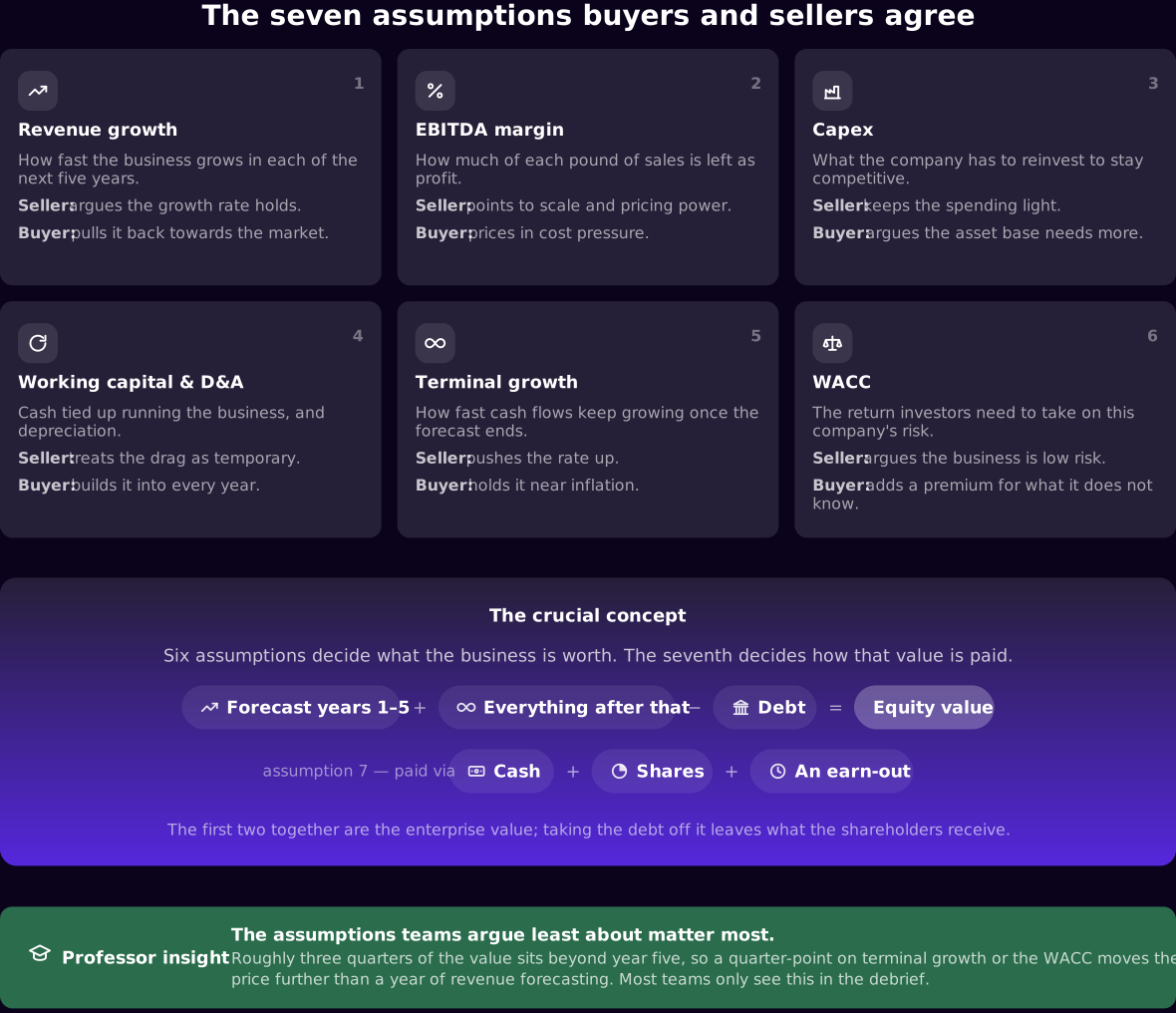

Agreeing a valuation one assumption at a time makes both teams open their model and justify every figure, instead of splitting the difference on a single price.
Most of the price comes from the years after the forecast ends, so a small change to the discount rate moves it more than a long argument about spending.
Two groups can agree the same price and still end up with very different deals, depending on how much is paid in cash rather than shares.
You run the session from the Admin Panel. Students move through the case, the Excel model and the deal table from a single screen.
Click a stage to move everyone there. Play runs the session by itself, Pause holds the clock, Stop locks student screens, and Adjust changes how long each stage runs.
Create teams, pair sellers with buyers, open any student's screen to see exactly what they see, and follow every team's numbers and chat as they go.
Send a message to the whole room mid-session. The First Time User Guide walks you through every control and shows you the student view before you run it live.
A checklist runs the stage. Teams enter the price they will open with, see how it compares with what similar companies are worth, and choose how much is cash.
The valuation moves as each assumption is settled, alongside the discount rate, how much of the value sits beyond the forecast, and how far each side has shifted.
Each team sees its own forecast against management's plan, and how its price and payment compare with every other group in the class.
Both sides get the same information pack, and each side gets its own private briefing on the other. Every team downloads the same Excel template, so any difference in value comes from judgement rather than from different data.
Issued by the seller's adviser to both sides: the business, three years of financial history, management's five-year plan, the client base, the market, similar listed companies, the debt and the market data needed for the discount rate. It sets out facts and recommends no price.
The seller learns things that support a higher price. The buyer learns things that support a lower one. Neither side sees the other's briefing, so each has to decide what to reveal and what to hold back.

6 mins
Four short parts: the deal and the two companies, how the simulation runs, how a DCF builds a price, and how teams are scored.
Assessment is optional and the simulation can be run ungraded. No grade is produced. You can download every team's results and the model it built, and weigh those alongside what you saw in the room.
The session can run by itself once started. Coaching is optional, and you keep control of teams, timings and pace throughout.
Step 1
Teams of three to five. Use an even number, so every seller is paired with a buyer to negotiate against.
Step 2
Keep the standard times, or change them to fit one class, two classes, or a window of several days.
Step 3
Play starts the clock, Pause holds it and Stop locks student screens. Nothing already submitted is lost.
Step 4
Follow teams as they work and download their models. Remind each group to approve its deal in time.
Everything needed to prepare, run and debrief the Valuation: M&A with DCF simulation is organised within the resources below.
About four hours in one block. Pause for short breaks.
Split at the stage break. Teams can finish their model between classes.
Teams build their model at home, then negotiate in class.
Everything happens online over about a week.
These industry professionals were involved in the inception, creation, development, testing and optimisation of the simulation.

Investment banking experience across UBS, Morgan Stanley, and Deutsche Bank. Studied Mathematics at Saratov University.

Former Practice Specialist in McKinsey’s Corporate Finance team in Germany and Finance professor at Aberdeen University.

Senior investment banker at Morgan Stanley with experience in M&A and TMT coverage across New York and San Francisco. Studied business at Kellogg.

Assistant Professor of Finance at Tilburg University, teaching corporate finance courses. Also lectures at TIAS Business School.

Worked in the finance department of Precomp Tools. Studied Engineering and holds an MSc in Corporate Finance from Bayes.
During the call, we can: